Friday, November 13, 2020

Cactus Cats of Balboa Park, Daguerreotype Dozen

 So much that a camera can do has yet been un-attempted, so many seemingly ubiquitous subjects have been limited to formulaic portrayal.  My passion for photography, and life-ling dedication to this most perfect of art forms, implores me to constantly reinvent myself, and, whenever possible, the medium I love so much.   In this project, I once again turned to documentary side of photography, the purest incarnation of this multi-faceted discipline. What could I do to make interesting images, while challenging myself and pushing the boundaries of how cameras have been used before. 


  Prior to this project, animals in their natural environment have never been the focus of daguerreotype images.  Pets and livestock have been subject of rare and sought-after plates from 1840-50s, and a few landscapes by skilled daguerreotypists of that time happen to catch a wandering cow or two, but no serious effort seems to have been made toward focusing on creatures in uncontrolled settings.  This really isn’t that big of a surprise.  With its low sensitivity to light, leading to long exposures, daguerreotypes require rather long exposures.  Add to that having to work with a bulky camera on a tripod, which has very shallow depth of focus from which the subject can’t move much.  On top of that, daguerreotypists usually tended to closely follow market demands, and portraiture was by far the easiest kind of images to get paid for.  Finally, preparation of plates is a tedious task, and if you’re not in any kind of control of your subject, a lot of trial and error comes into play rather quickly.   These challenges served as pure enticement to me when I learned of a colony of feral cats at our local park.  


  I was never truly a cat person, always related more to openness and sincerity of dogs, but I respect all animals, and enjoy getting in touch with their energy.  As most people are probably aware of, cats are among the least cooperative of all subjects, so I knew this was going to take a lot of patience and dedication.   Starting in early October, on nearly daily basis, I paid visits to this liberated feline hangout, armed with one or two plates ready for exposure.  The goal was to catch these creatures in candid moments amid their favorite backgrounds.  They spend midday deep in the bushes, hiding from relentless San Diego sun, and prefer to emerge only an hour or two before sunset.  These kitties also don’t like to hang out in open spaces much, preferring deep shade of some low cactus or palm, which made exposure times range wildly, from 7 to 60 seconds, with most being 15-20sec.  More often than not some noise from a nearby freeway or appearance of a fellow troop member made my subjects move mid-exposure, but I never let that discourage me from trying again and again.  Some individuals were just impossibly jittery, even when they sat or lounged their heads would be turning every two seconds, scanning surroundings for danger.  Others were relatively comfortable with my presence, and all I had to do was not move too fast and hope that no sudden noises would scare them.  Basically, seeing each successful plate coming out of my developing chamber felt like a miracle every time.  


  I can honestly say that this was the most difficult photographic project I’ve completed so far.  Sure, there have been much more complex works that took me many more attempts than I could have ever expected, but in those instances I was usually shooting for something so well defined in my imagination that I could not deviate from that goal.  This time though, no preconceived notions of specific compositions existed in my imagination, the only aim was beauty and uniqueness.   I was working in a strictly documentary style with a live subject, which I had zero control over, and so my patience and intuition had to be pushed to their limits.   Due to relatively high level of difficulty of this project, I gave myself a bit more leeway in terms of possible acceptance of plates with more slight imperfections that I normally would allow myself to have.   There was no way though I could bring myself to erase them, I mean look at that cuteness!   Also, please do keep in mind, as always, that daguerreotypes are different from every other medium you have ever seen.  There’s no way to really translate how each unique plate truly look in real life; thus images below are to be taken as a guide to their appearance. When examined live all these plates look considerably better than what I was able to achieve in copying them for this post, but only those who purchase each plate, and their guests of honor, will have a pleasure of experiencing these plate live.  


Anton


P.S.  These 12 original plates are now available for purchase on first come basis.  Prices range from $1200 to $2500 depending on which plate it is, so please do feel free to email with inquiries.

Friday, November 6, 2020

Pandemic Summer, Silver Image Medley in Daguerreotype & Collodion

  In this third and final catch-up post, I will briefly explore various inspirations of this summer and images resulting from them.  Perhaps the reader can gain a bit of insight to what makes me tick, and what makes me aim my camera in directions I choose. 
  While subject matter varies broadly, all images are united by my unwavering conviction that beauty will save the world, and that in production of these works I not only find myself, but also bring a spark of joy to those who will see them and, in case of personal encounter, feel their weight in hand. 


  DANDELION  
  While on the patio of a local coffee shop, on a beautiful summer day, I was daydreaming about open sun-soaked meadows, flanked by shady mixed forests, taller blades of glass gently swaying in warm breeze.  It’s been a while since I laid in such a meadow.  Such meadows allow one to clear a lot from the mind, allow one to simply be and feel Earth’s breath.
  On the way back, right by the car, I noticed a small dandelion sprouting out from a sidewalk crack.  It was ready to shed its tiny seeds, and I could feel the hope for them to be in that same meadow I was just picturing.  I carefully brought it to the studio, and made this daguerreotype in a manner in which I would have seen it against the sky while we were both there, in Nature.  
  Blue is part of the process, and other coloring was added by hand.
  After the shoot, I took it to the local canyon, and released the seeds.


Dandelion, 1/6th Plate Hand Tinted Daguerreotype (SOLD)


WALKABOUTS
  In Australian aboriginal societies, a walkabout it a rite of passage, a spiritual quest, undertaken in solitude, with aim of connecting with Nature, and finding your spirit within it.   For me photography has provided this experience. Walking out of my darkroom with a daguerreotype plate in-hand and camera slung over my shoulder, is my spiritual experience.  All preconceived notions are shed, and I let the direction of my search be guided by the great flow of energy, which comprises all matter including myself.  It’s hard to explain, it’s as if light itself makes me turn down this street or the other.  Eventually I see something that asks to be upon my plate, and this is how the plates below came about.  It can be light striking bark of a tree, or a scene within geometry of which I glimpse my own ghost.  Plates made in this manner are most precious to me, as they best sing praise to what I regard as photography’s highest honor; its inherently perfect potential of distilling visual experience of life into permanent impressions. 

San Diego Naval Hospital, 4x5in Daguerreotype (SOLD)


Ghost of Self, 4x5in Daguerreotype (SOLD)


'65 Mustang, 4x5in Daguerreotype


No More Turning Away, 4x5in Daguerreotype


Tree in Sun, 4x5in Daguerreotype (SOLD)


WATER TOWER
  Not far from my darkroom is San Diego North Park water tower, a local iconic landmark.  When about 5 years ago, I for the first time felt confident enough to take a daguerreotype plate outdoors, it was this tower that drew me in. I still have that plate.  Later I made a small distant view, and traded that one with a daguerreotype artist from Germany for one of his plates featuring a water tower in his hometown. 
  On one of the above-mentioned walkabouts, I was once again drawn to this looming structure, but this time the tower demanded to be pictured differently.  Standing in front of it, I saw the layers of history over which the tower reined, and to tides of which it will eventually succumb, a host to its own ghosts.  It took a concerted effort to make this plate come about.  Day after day, I kept going back, chasing this delineated transparency within complexity of a triple exposure.  Vision is paramount in art.  Once conjured, it can’t be compromised. 

North Park Water Tower, 4x5in Daguerreotype (SOLD)


GERBERA
  Perfection can often be found within simplicity, one just has to be observant and trust their intuition.
  While passing a local flower shop on the way for morning coffee, I saw a bundle of gerberas near a window, and their colors snuck a smile under my mask.  Upon getting closer, one flower in particular called my attention, and I thought how interesting it is that space seems to change depth and texture in moments like that. Depth perception is a product of our minds after all, so I wondered how I could capture that feeling of multidimensional effect. 
  Sometimes, when I want something very precise, I shoot some tintypes of a scene before going to daguerreotype.  Doing this is very much like making Polaroid tests for final exposure onto slide film, they have about the same ISO and nearly identical spectral response.  I did 8-9 test plates, moving lights and adjusting background, but nothing seemed just right, and it always seemed like my vision escaped me by just a little bit, with image, in order to be perfect, needing to have attributes of several plates combined.  I then stopped my testing, buffed and fumed a daguerreotype plate, and for this first attempt, seen below, moved lights mid-exposure based on what I saw them yield during various tests.  I was thrilled to see the plate come up just as I wanted.  
  As last step, I added color via hand tinting to bring life and depth to the image.  It’s nearly impossible to capture the look of this piece, but I believe this angle represents it as well as a still image can. 


Gerbera, 4x5in Hand Tinted Daguerreotype


BANYAN TREE
  I’ve been visiting this tree in Balboa Park for over twenty years.  It was as magnificent then as it stands now, and one day I got a hankering to immortalize it in daguerreotype form.  This pursuit ended up requiring a lot more effort than initially bargained for.  
  This tree is enormous, with crown circumference of well over 20m, has very dense leaves that are fully opaque, and has a boardwalk wrapping around with branches reaching down to just above head level.  This combination meant that almost no UV light is available by the trunk even midday, and I wanted to avoid splotchy sunlight, so had to wait until just prior to sunset.  Another problem was in representing something this overwhelmingly large and somehow making sense of it, while fitting most of it in frame.  This was one of the few times I knew nothing short of 65mm would suffice.  Luckily, a couple years ago I came into possession of an Orbitar camera, a dedicated wide-angle 4x5 by Burke and James, with a 65mm Schneider Super-Angulon.   That version of the lens being f8 at it’s most open didn’t make composing any easier, but after crouching between the roots a few times, and finally figuring out that my exposure at desired f16 should in fact be a whopping one hour, I did come away with image below, with which I was very happy. 


Banyan Tree, 4x5in Daguerreotype (SOLD)


CIRCLES AND LINES TRIPTYCH 
  Sometimes images appear from ideas, and those ideas are not exactly rooted in physical world. They call to be expressed through empirical experiments, guided by no more than a hunch or faint mirage, as of an owl seen through fog.  Where does the owl start and fog ends?  Tips of its wings, brushed against the circle of the moon.  How do they interact?

Cicles and Lines, 4x5in Daguerreotypes
  
APARTMENT HOUSE 
  Modern architecture rarely inspires me.  Sterile and lifeless in its core, yet trying so hard to be different, with its brash colors, angles, and finish, it makes me wish I could do something about it.
  A new condominium building went up right in the middle of what used to be a street with a solid pre-WWII feel.  It is finished in shiny metal of fire engine red color, and stands there like a fractured clowns nose.  It looks so comically out of place that it often reminds me of going to Moscow circus, and so on this plate I decided to treat it a similarly chaotically colorful manner. 
There Must Have Been a Door, 4x5in Daguerreotype

WAY THINGS WERE
  Just after the end of strict phase of quarantine (which I will mention was nowhere near as strict as it should have been), I took the larger of my dark boxes, and headed out to a local canyon park, and with Jozlynn, my favorite model.  
  Purity calmed by simplicity is effervescent and engaging, and in these plates we worked to portray this primordial spirit. 
  A small technical note of sorrow is in order.  After making one of the below plates I learned that the purple glass it is made on is no longer produced.  The last company that made colored glass for ambrotypes moved production a few years ago, and since then has discontinued some colors in smooth finish.  This beautifully deep purple color is exceptionally close to 1850s, so it was sad to learn of its demise.  I still have a little bit left, so I’ll treat it with special care for pieces like this.  The image can be lit from back to reveal its negative form, when backed with any surface and lit from front, it will yield a perfectly black and white look, but if light is balanced to come from both front and back (maybe 80/20 split), the piece will appear split-toned. A true delight to view and behold. 


Respite, 8x10in Tintype
Ghost of Old Normal, 8x10in Black Glass Ambrotype
Quest, 8x10in Purple Glass Ambrotype (negative view)
Quest, 8x10in Purple Glass Ambrotype (positive view)
Quest, 8x10in Purple Glass Ambrotype (split tone view)
1850 Purple Glass Ambrotype Example, backlit

FIGHTER
  Another quick collaboration resulted in this 8x10 studio tintype.   Jozlynn works in the medical field, and we wanted to pay tribute to those who risk their lives and serve society during a pandemic. I didn’t want to make prop covid molecules like I’ve seen many resort to, and I think these thistles are perfect; they are both reminiscent of the shape we have been shown by scientists, and they also stick to you if you aren’t careful, just like the virus does.  This image was made in-camera with 4 exposures and I couldn’t be happier with the way it carries initial concept. 
Fighter, 8x10in Tintype

  A debt of gratitude is owed to individuals around the globe who have purchased plates marked as sold.  I truly appreciate it, and wouldn’t be able to continue making work if it wasn’t for that support.
  Should You wish to add any of above daguerreotypes or wet plate collodion works to Your art collection, please do feel free to send a message. 
Anton

Thursday, October 1, 2020

Wet Plate Collodion Amid Pandemic

Wet Plate Collodion Amid Pandemic


  Shortly after Yosemite trip, Covid-19 virus started to really spread.  Everything stopped, people were ordered to stay inside as much as possible, and life seemed to have frozen in its tracks.  I isolated myself in my studio/darkroom, and, like I’m sure many among us, fell into a bit of a depression, in part due to losing all prospects of work for the foreseeable future. 
  For days and weeks, I meandered about my little space, cleaning, organizing, maintaining chemistry, reading, sleeping way more than usual…  When going outside, it was strange not to see people’s smiles or even frowns; everyone was masked, and crossed the street upon approach as if whoever was coming their was wielding a machete and was covered in pig blood.   It was weird.  I found myself staying in the darkroom longer and longer, days seem to stretch on without end. 

  There have been other periods in my life when energy was low, so low that it seemed hopeless.  In the past, making art was what never failed to dispel those clouds, and so I knew I needed to shoot something; something new for me, something that would push the limits of my own comfort zone. 


  Depression makes you feel small, alone, defenseless, and venerable.  When there’s nowhere to go and no motivation to do anything, even walls of my cozy and dearly beloved little studio start to seem like a cage. 

  In the past I rarely turned my camera upon myself, I’m not Cindy Sherman, but occasionally a self-portrait idea seems valid and worthy, and so it did this time around.  I also don’t usually shoot nudes, and certainly never before have pictured myself a la natural, so this was going to be a push in a new direction. 

  I knew that my friend Justin, whose office is in next building over, had a small collection of vintage gas masks, so I asked to borrow one with a long tube, which resembles an elephant trunk.  After all, elephants never forget.  They never forget the good times they had, and they know where water is even amid historic drought.

  A fun challenge when doing self-portraits with wet plate is how to handle lighting and camera operation.  In studio I use flash, and usually trigger it with a light meter, which is the only thing I now use that tool for.  However, I didn’t want to have anything electronic in my hands, or have the cord showing.  Fun solution was to hide the light meter in background folds in the corner, get in position, and find the trigger button with my pinky toe.  Below are the two 4x5 ambrotype images I made that evening.  One was made on deep purple glass, and one on green.   


  First attempt was made on green glass.  When I saw it after clearing in fixer, I wasn’t convinced that it’s the best I could do, so went for the purple one.  Satisfied with that outcome, I turned my attention back to green plate, and figured out how it needed to be finished in order to make me happy.  Ambrotypes on colored glass, traditionally known as ‘ruby glass’ ambrotypes no matter what color glass is actually used, have an interesting quality.   When you lay them down on a table or anything darker than medium grey, they look almost perfectly like a tintype, or usual black-backed ambrotypes.  Some cast may remain, especially under strong lighting, and you can see a bit of it in the purple plate above.  When you back them up with black, almost no color comes bath through, but put something white behind them and you get a great duochrome effect.  Green is a color often associated with disease, and all the collodion artifacts that appeared around me in first plate seemed reminiscent of swirls of air, laden with Covid particles, ready to envelop and attack me.  To create the above affect, green ambrotype was backed with white mat board, and the area I wanted to have no color was painted black. 

  I was really happy with how both plates came out, and was even happier when, while picking up the loaned mask, Justin saw the purple one and purchased it on the spot.   In fact, he liked it so much that he wanted to see how he would look in similar setting and on larger 8x10 plate.  A few days later, tintype below was born. 


  Meanwhile the virus raged on. It was not long until worldwide death toll reached 100.000.  Justin had been collecting newspapers with large pandemic-related headlines, and suggested making a plate with the paper from the day this grim milestone was reached.  Bus stop location was selected to represent the old mundane routine in a new way.  Tintypes are always laterally reversed, so writing there is backwards, and that adds another small part to the surreal situation we all found ourselves in. 


  A few months passed, and US surged in number of Covid-19 cases as if it was a numbers race to impress the whole world.  Well, the world was very impressed.  Impressed with sheer stupidity of anti-maskers, complete disconnect of current government officials from science and common sense, their inability to act according to protocols set up for decades for just these types of emergencies, with amount of lying and concealing, stonewalling and demagoguery; basically impressed all around.  In what seemed like no time at all, death toll hit 100.000 in just USA.  Among them were my great aunt, who, up until the virus, was going strong at her age of 92, and had to die alone with none of her few remaining relatives around her.  I also hear of the passing of very kind and talented artist I knew and interacted with a lot, who lived in upstate New York and was I believe in his late 50s.  Debates though raged on.  Is it worth shutting down the economy over a few saved lives?  I doubt it’s a question many of those who personally know someone who died would be asking, but the voices of oblivious were ringing louder and louder.  Plus, terrible things kept happening again and again with police brutality reaching boiling points, and erupting in protests all over the country.  And then there’s the fact that’s in an election year, and there’s a good percentage of population who are very rightly worried about actual survival of democracy this time around, and so conversation around that topic got louder and louder.  Basically, the virus seemed to have fallen in ranking of importance, and life seemed to have moved right along.   So with the 100.000 US deaths headline, we made the following plate. 


  Of all above plates, only the green 4x5 ambrotype remains available.  All 8x10in plates have been purchased by private collectors, and, as mentioned above, purple 4x5 is residing with Justin.  


Anton

Saturday, September 26, 2020

Yosemite Wet Plate Collodion and Daguerreotype Adventure

In January this year I took a trip to one of California’s true natural gems – Yosemite National Park.  The aim of this trip was to make a couple daguerreotypes, and to give a new camera I acquired in 2019 it’s first workout in over a century.  I traveled there with a friend, whose airport shuttle converted into a darkroom was to be the used for creation of our work.  In retrospect that was a mistake, but more about that a little later when we get to daguerreotypes. 


  The new camera I happened to have found with help from a friend in Colorado is a pretty special one.  It is an 8x10 field wet plate collodion model, made by American Optical Company in mid 1870s.  By then, Scovill already acquired the company, but kept it as a separate entity, marketing that line of products as higher quality built. 


  Cameras from 1870s are fairly rare, and vast majority of the ones that get unearthed are studio models.  Those cameras stayed indoors, resting comfortably atop rolling stands, and so they survived in much better shape, plus I think there may have been just more of them than field models.  Even with studio camera, it’s a fact that finding one with a matching and working plate holder is nearly impossible, and is always considered a medium-sized miracle.   Silver nitrate is a strong corrosive, and those wooden plate holders absorbed it little by little from drips of one plate after another, and over time the wood swelled, rotted, and rendered 99% of those holders completely unusable.  My suspicion, since each holder was made specifically for each camera, is that photographers would have used their setup until the holder became junk, and then stop using that camera all together, rather than sending in the back standard to have a new holder fitted. I was overjoyed to have found this camera with a nearly 100% intact plate holder.


  By all signs I can find, the camera was well used, but with much care.  Original silver stains from wet plate era are overly abundant, and over time in one corner of rear door it even made a beautiful reflective silver surface.  Inside the holder were two reducing inserts; one original for wet collodion plates in 5x8in size, and inside that a smaller homemade one for 4x5in. The 4x5 inserts looks used, but lacks any sign of silver nitrate, so I suspect that is was made as dry plates became available, and used in second half of its original service.  After a while, I can’t imagine how many thousands of images that could be, original wooden dark slide wore down so much on two end corners, that it started to have a gap, which would have let in large amounts of light, and so I recon that’s when the camera was finally retired for good.  Somehow this camera ended up in possession of a Colorado hoarder, where it sat for an unknown length of time before being rescued by my friend.  When it got to me, the only thing I had to do to the body was replacing the bellows, as original set was made of cloth dipped in early form of rubber, and though I am sure it would have been amazing and beautiful when new, after 150 years that rubber became hard as a rock, and would crack and chip every time I tried to stretch it.  Replacing bellows and making a new dark slide out of some plastic were the only two things I had to do to get my new 150 year old baby back in shooting order.  Also, because this camera takes really odd sized lens boards, it made most sense to put a universal iris flange on there, so any number of lenses can be put on that same board in seconds.
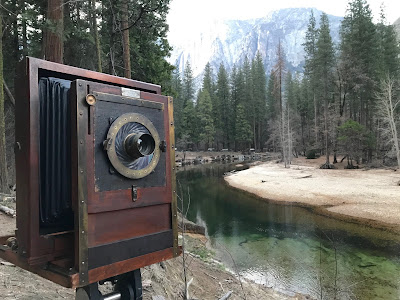

  There were two full days of shooting on this trip, and I decided to dedicate the first day to shooting wet plate collodion, and second day to daguerreotypes.  Yosemite is a magical place, and if one points their camera in almost any direction, they will be rewarded with a beautiful frame.  Still, I wanted to make my images stand apart from others.  With me I brought a variety of wet plate era lenses, but I think I ended up using mostly just three of them – 8in Dallmeyer Triple Achromat from 1864, 12in James Queen Single Achromat from mid 1870s, and 16in Voigtlander Euryscope ca. 1880.  A landscape photographer from 19th century could have easily had any one of these lenses in their wagon, as all of them are superb for making views.  Dallmeyer lens actually came together with the camera from same estate, and so it really could have been together with my camera back then.


  Working with a new camera is usually a bit nerve wrecking, because one has to readjust a bit to get used to quirks and specificities of each apparatus, but not in this case.  As soon as the camera was up on a tripod, it started working as if I’ve had it all my life.  All controls are exactly where they need to be, and, after waiting for 150 years, plate holder slid into position as if drawn in by magnets.  I made 9-10 plates in 2-3 locations, and here’s a selection of those 8x10s.  These unique original plates are now available for purchase with prices ranging from $500 to $800 per plate. 


  Second day was to be a day of daguerreotype.   We had another two wet plate photographers join us, which was rather distracting.  Even though they used their own setups, there’s still a lot of mental energy that goes into interacting in a group of 4 rather than 2.  My mind was also scrambled by a conversation with one of those two, during which I found out that this particular person is unwilling to commit one way or the other to the actual shape of our planet, believe moon landing is fake, and considers willful ignorance to me morally superior to strict adherence to facts of and scientific methods.  I tried discarding that information, but to be in physical presence of such blatant and proud denial was simply depressing.   The other factor that was working against me was that I was operating in a brand new to me darkroom, one that has been built by a great wet plate photographer, but built strictly in a minimalist utilitarian manner.  And yeah, I had to pack all equipment and chemistry and glassware and cameras and lenses for both 8x10 wet plate and 4x5 daguerreotype processes, which is a ton of stuff let me tell you.  


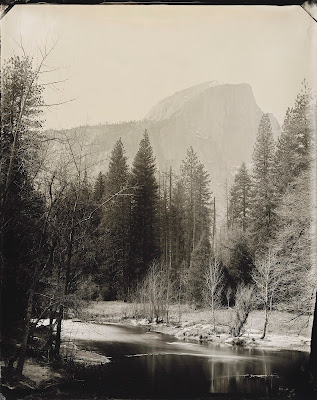
  First parking spot was at the Tunnel View overlook, which is about the most known and visited spot, where thousands of images are made each day.  No matter though, I don’t think a lot of daguerreotypes have been made from there (actually I think none ever have).   Working in a new space, and having people in and out the darkroom and all around me didn’t make for an easy start.  First two plates were not to my liking.  By the time I got third plate exposed, the other folks were done shooting collodion, and were waiting to move on.   When I cleared the plate in fixer I couldn’t believe it.  A most perfect plate I have ever made was staring up at me though thin cover of hypo.   I called over the others, and each of them let out an audible gasp when they saw it.  I explained to folks not to be too excited, as there’s still a chance to mess it all up in gilding.  It’s true, that’s the last step in the process, and it can go horribly wrong if done haphazardly, but I haven’t had it turn disastrous in a while, so there was a degree of confidence.  The image was so beautiful that my hands trembled as I washed it and mixed gilding solution.  The crowd all gathered inside the darkroom, mesmerized by the still unfinished plate.  It is during this moment I discovered that the only thing I forgot from 100 pieces of equipment was my super clean gold chloride mixing beaker.   Panic set in, and it soon became apparent that aboard the large vehicle stuffed with beakers and trays and all other things relating to photography, there was not a single clean container.  I mean the whole darkroom was technically one large silver nitrate stain, but I didn’t have to lick the tables or eat off the floor, all I needed was one 20-50ml beaker that was clean.  Nope, that wasn’t in the cards.  I selected the most stain-free plastic beaker and washed and scrubbed it best I could.  When first mixing gold and hypo, and if things are contaminated, solution can turn black instead of golden yellow.  That didn’t happen, and so I was optimistic.  I lit my alcohol burner and set it on table behind me.  With reverent care, I placed my precious plate atop the gilding stand, and poured gold solution over it.  I turned around to get my burner, and when I turned back it was as if I was hit with a meteorite.  Where just 2 seconds ago there was an image with every branch of every tree in the valley defines as if real, with Yosemite falls so pure and powerful, with Half Dome so mythical and misty, seen through purple opalescence amid atmospheric perspective, now there was nothing by a milky puddle of white cloudy solution, through with I could see only the delineation of sky against horizon, and even that barely so.  I was speechless, staring down at it with a lit burner in my hand, I think my mouth opened but no sound came out.  People around me were asking ‘what happened’, but I just couldn’t talk, it felt like I just got shot.  When I described what happened to folks who know chemistry a bit more, they said it was most likely the tiniest amount of silver nitrate on the lip of that cursed beaker contaminated the solution as I was pouring it onto the plate, and caused some sort of a reaction that I have never seen before.  The image was gone though, not a trace. 
  I could barely talk for the rest of the day, but managed to pull myself together just enough to make one more plate at the next location.  It is a very good plate, no doubt about it, and I would have been thrilled with it had I not seen the absolute perfection that just got obliterated in front of my eyes.   Still, I had enough strength of mind not to gild second plate there, and kept it in water until we got to a place where I could find a single clean cup.  Here’s that one and only daguerreotype of El Capitan, with it’s famous ‘heart’ showing and well lit.  This plate has been sold.


  In conclusion, I would like to say that it’s always best to work with your own setup, one that you know by heart, and where all objects may still be dirty, but they are dirty in a way that you know them to be.  Also, I am in love with that American Optical 8x10, and I think it will become my main location wet plate camera.


All the very best,

Anton.


Note - This is a catch-up post, and I will write a few of these to cover activity from first part of 2020.  In order to keep all 4 parts of Daguerrean Dream series together, I skipped posting until it was all finished, so there’s a bit of a backlog of images to post. 


P.S.  If you think that through millennia all the millions of scientists alive have been a part of a perfectly coordinated multi-cultural multi-generational conspiracy to make you think that the Earth is round, when in fact it’s not, then you are a very special kind of human; the

 rare kind that I don’t ever want to cross paths with.

Friday, September 11, 2020

Daguerrean Dream, Visual Symphony - Part IV

Daguerrean Dream

Visual Symphony – Part IV

Etat Soutenu


  From the very first moment we gain consciousness, to the time it leaves us, all our experiences are sustained and defined by neurological system of the brain.  Physical sensations, emotions, and dreams are stored within and interpreted by the same biochemical system of neurons, a nebulous grey matter web.  What is real, what is normal, what is beautiful or ugly, all determined and catalogued within the same confined space we call our mind.  Stacked and staggered impulses blend into a fine mesh of perception.  Fantasy and and reality seem to dissolve each other and morph, as we are carried forth by fabric of time.  Cranial wonders, secrets, and revelations guide us along an essentially existential experience of continuity.

  Encounters during waking hours may be as fleeting or as significant as those during dreamtime.  Both can have as little or as much impact as we choose, and both add color to our awareness of self and all that surrounds us.  While passing days bring tangible objects to which we assign a label of being real, times of rest provide for time during which a cocktail of truth and fiction flows unabated into shapes of its fancy, only rarely providing us with any degree of control.  Life is a blend of the two, nothing more, nothing less.  Amount of attention paid to proportions within this mix, and to which we decide to assign more significance, largely determines our journey through larger tale of history.


  Consisting of ten 4x5in plates, Part IV of Daguerrean Dream series addresses my take on that which supports the state of my Being.  Cacophonic selection of real objects and dream visions, fixed upon silver plates in roughly chronological order.   As in life, continuity, afforded to us by things physical and familiar, is maintained via nano-scale network, one that is living and ever evolving.  Daguerreotype technique is most natural choice for best representation of a singularly unique path of ones lifetime.  With nearly infinite detail, and being intrinsically unrepeatable, daguerreotype images have their own personal presence.  Opalescence effect is akin to the dynamism of neurologic network, with its lively play of color and shift of tone, changing right in front of your eyes. No two connections and no two interactions will be the same, just like in life we can’t walk into the same river twice.  Infamously difficult to reproduce in digital or printed media, each of these daguerreotype plates will outlive me by hundreds of years, and will refract light from their surface and into the eyes of those who hold them in same way my eye saw it.

  For daguerreotypes, video presentation format provides an experience most closely reminiscent of actual in-person examination.  A moving image also mimics the play we see unfold in front of us as, we make our way from start to finish of life.


Anton